September 3, 2026
A global snapshot: who answered this year’s ICOM COMMS call Conference, Conferencia, Network
A global snapshot: who answered this year’s ICOM COMMS call
This year, ICOM COMMS opened three calls at once: proposals for the ICOM COMMS + ICOMON Annual Conference, entries for the COMMS Awards, and applications for the COMMS New Talents grant. Together they form a single moment when we can see, in aggregate, who our community actually is — where people work, how they found us, and what brings them to museum communications in the first place.
And we are so happy with the result: 187 people from 62 countries and five continents took part across the three calls, submitting a combined 243 proposals, entries and applications. Here is what that participation looked like.
A genuinely international pool
Across the three calls, Europe and Asia each account for roughly a third of participants, with Africa, South America and North America together making up the rest. That balance held up during the Conference call as well: of its individual proposers, 44 were based in Europe, 44 in Asia, 20 in Africa, 14 in South America, and 6 in North America.
Sixty-two countries are represented in total. Iran, Brazil and Egypt lead the count this year, followed closely by Finland — a natural reflection of the conference’s host country — and Italy. But the long tail is just as telling: single proposals arrived from countries such as Namibia, Uzbekistan, Mongolia, Cameroon, Panama, Rwanda and Yemen, extending the map well beyond the countries that appear most often.
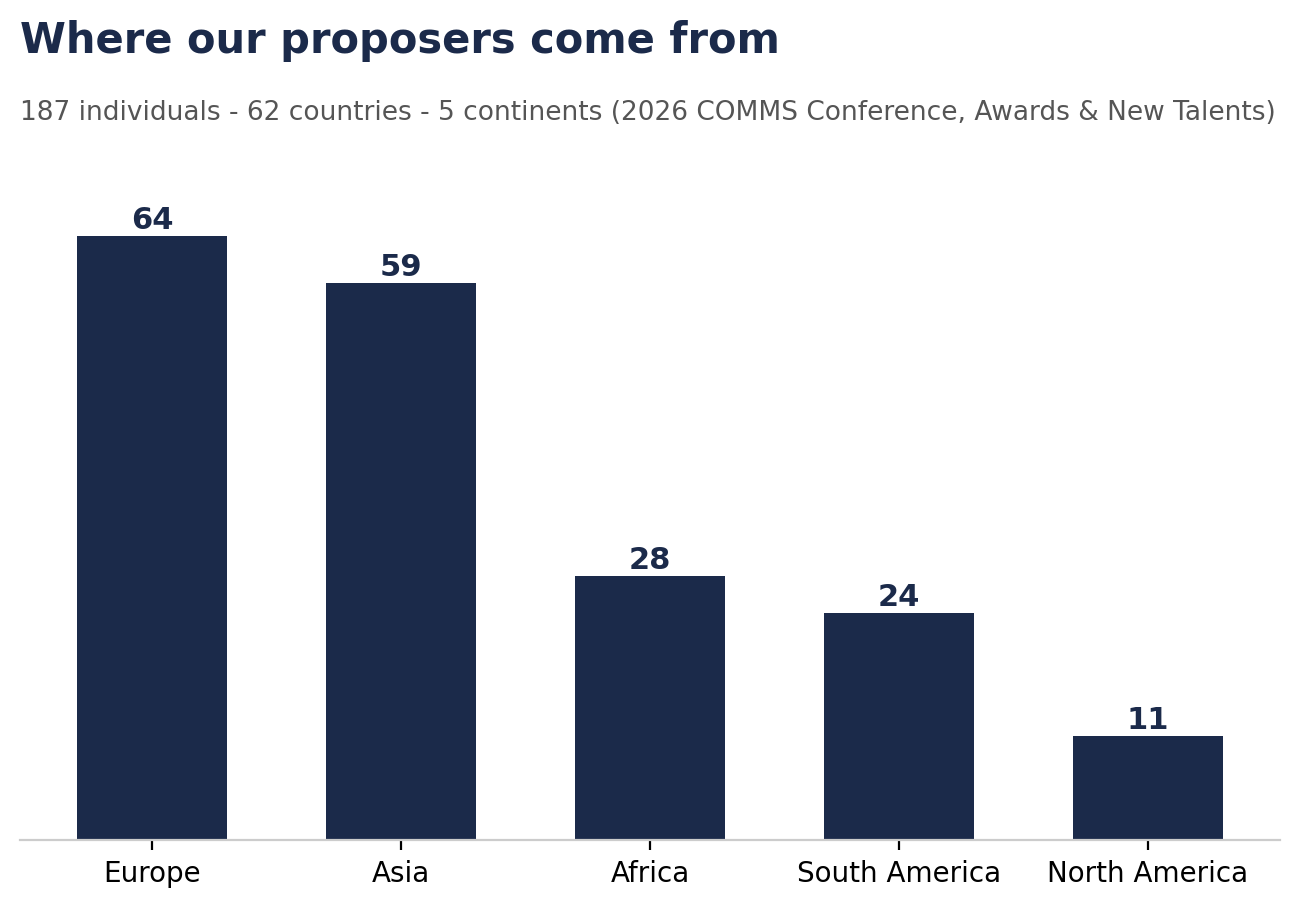
The three calls also skew differently in where they draw from. The Conference call and the Awards both lean toward Europe, Asia and South America, while New Talents — the grant aimed at emerging professionals — drew a third of its applicants from Africa this year, more than from any other continent.
Reaching beyond the existing membership
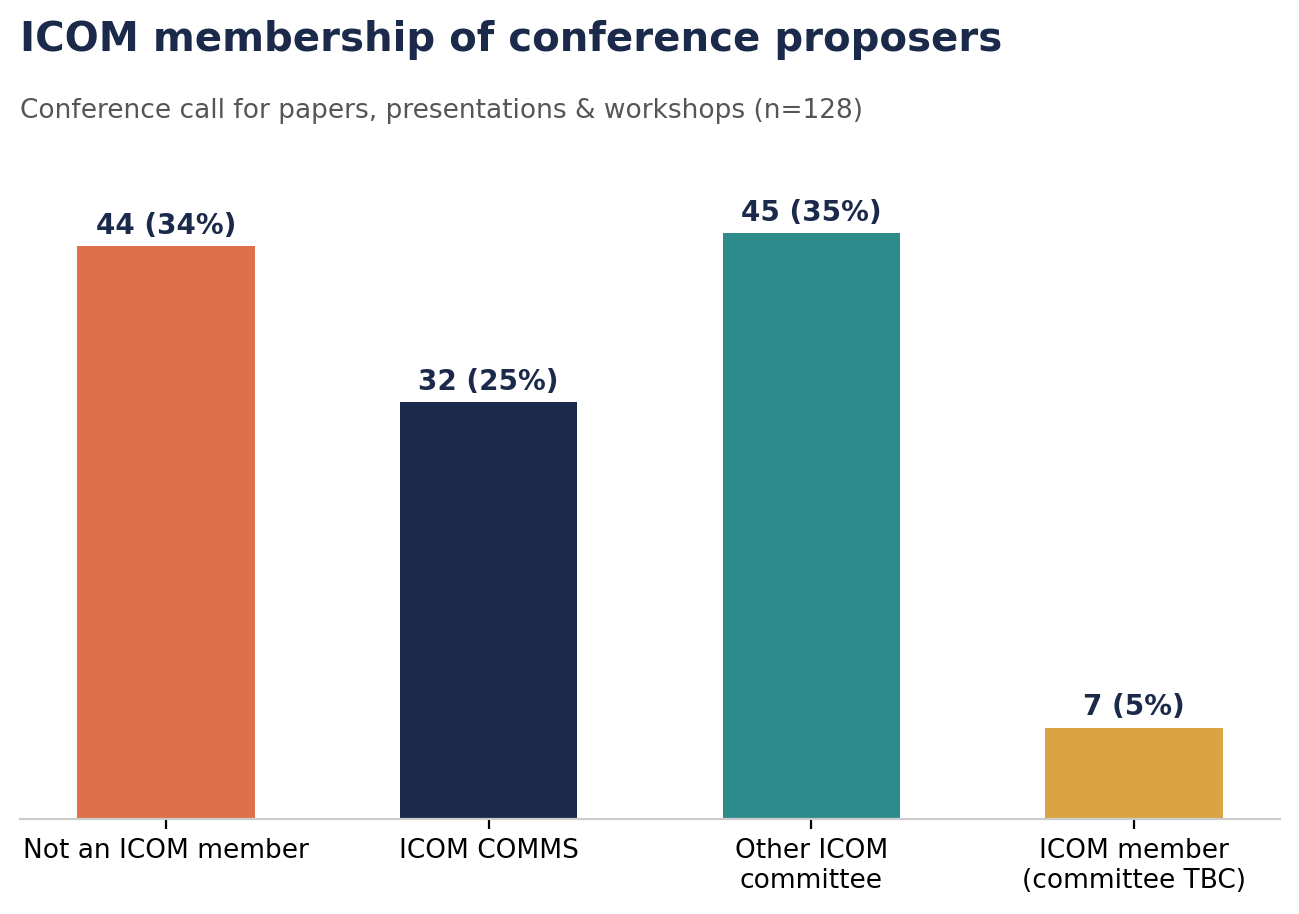
Looking at the Conference call, where proposers were asked to name their ICOM committee, 84 of 128 proposers (66%) identified as ICOM members of some kind, and 44 (34%) are not ICOM members at all. Within that membership, ICOM COMMS itself accounts for 32 proposers (25% of the total pool) — meaning three out of every four people who submitted a conference proposal came from outside our own committee, either through another ICOM committee or from outside ICOM entirely.
The Awards call shows a similar pattern from a different angle: of 61 entrants, 23 (38%) identified as ICOM COMMS members and 37 (61%) did not. Taken together, both calls suggest the same thing — this year’s outreach is reaching well beyond the committee’s existing membership base, into the wider ICOM network and beyond.
New Talents stands apart here by design, since the grant is reserved for ICOM members. Its diversity shows up instead in geography and career stage — see below.
More than a communications crowd
Reading through what proposers wrote about their own work, communications, marketing and PR roles form the largest single group at 31% — unsurprising for a communications committee’s own calls. But that leaves roughly seven in ten proposers describing themselves first as something else: education and public-program staff (21%), curators and collections specialists (11%), digital and technology practitioners (11%), and academics or researchers (11%), with smaller shares in conservation, museum leadership and design.
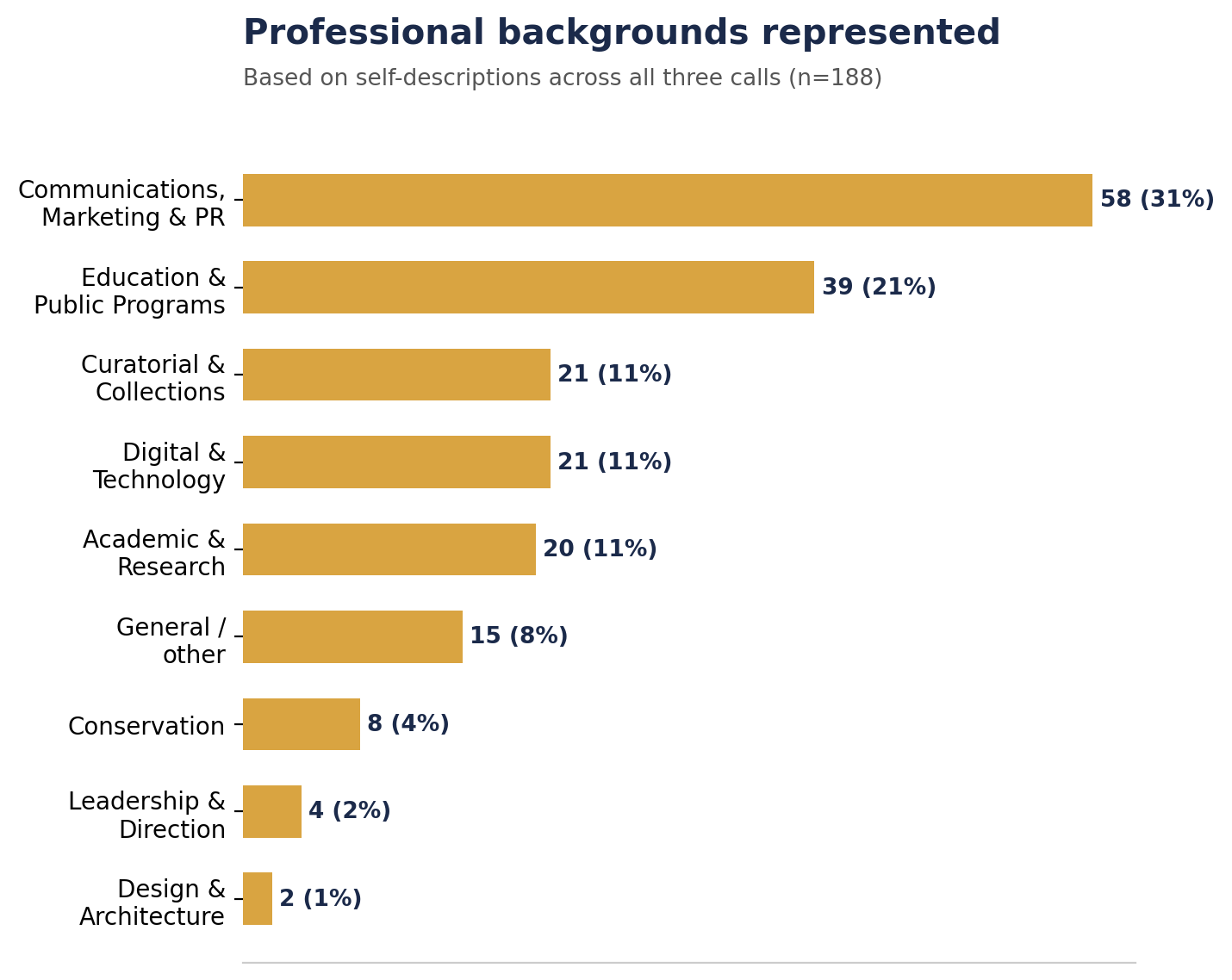
That spread matters for a communications committee specifically, because it suggests the topic is being picked up well outside the communications department — by curators thinking about how to talk about their exhibitions, by educators designing outreach, by directors setting institutional strategy.
A wider New Talents pool
Age is the field proposers shared least consistently, but where it was mentioned, two patterns stand out. Among Conference proposers who gave their age (65 of 128), the largest groups were in their 30s and 40s, together accounting for about three-quarters of that group, with smaller shares under 30 or over 50. Among New Talents applicants — a grant explicitly aimed at emerging professionals — the skew is even younger: of the 20 applicants who reported their age, 17 (85%) were under 40.
The takeaway
Put together, this year’s numbers describe a call that is reaching well past ICOM COMMS’s existing circle: geographically, into 62 countries across five continents; professionally, into departments far beyond communications; and institutionally, into museums and cultural organizations with no prior ICOM affiliation at all. Whatever institutions ultimately move forward, the pool from which this data is drawn is, by any measure, international and cross-disciplinary.